

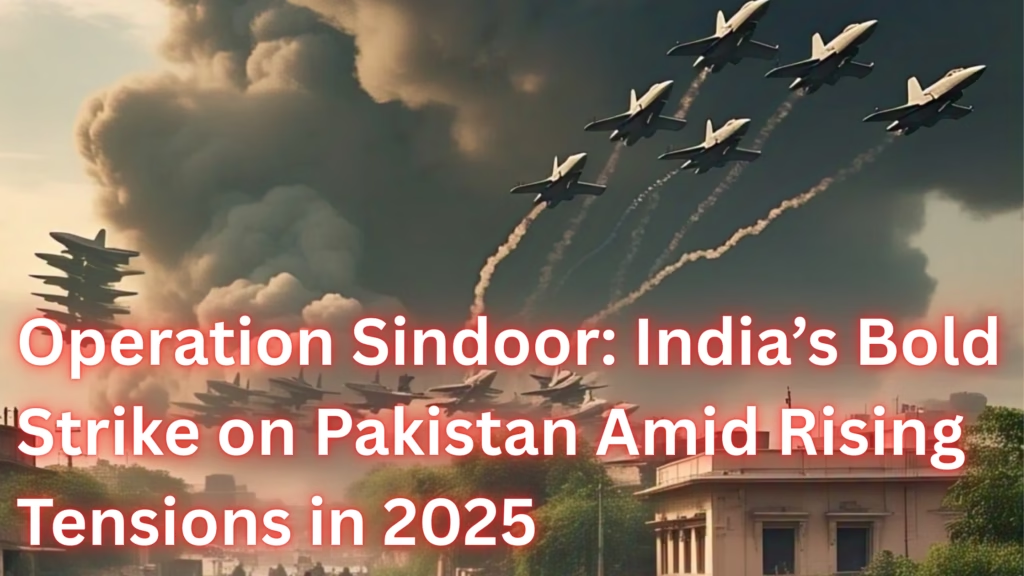
Table of Contents-Operation Sindoor: India’s Bold Strike on Pakistan Amid Rising Tensions in 2025
- Background: The Pahalgam Attack and Rising Tensions
- Operation Sindoor: India’s Military Response
- Damage Assessment from the Conflict
- Economic and Humanitarian Impact
- Global Reactions and Diplomatic Efforts
- Implications for the Oil and Gas Sector
- Looking Ahead
Background: The Pahalgam Attack and Rising Tensions
On April 22, 2025, a devastating terrorist attack in the Baisaran Valley near Pahalgam, Jammu and Kashmir, claimed 26 lives—25 Hindus, one Christian, and one local Muslim—targeting non-Muslims after interrogating their religious identities. The Resistance Front (TRF), suspected to be linked to Pakistan-based Lashkar-e-Taiba, initially claimed responsibility but later retracted it. India accused Pakistan of orchestrating the attack, identifying two Pakistani nationals among the three attackers, while Pakistan denied involvement and called for a neutral investigation.
India responded with diplomatic measures: suspending the Indus Waters Treaty, closing the Attari-Wagah border, expelling Pakistani diplomats, canceling visas for Pakistani nationals, and banning Pakistani flights from its airspace. Pakistan retaliated by suspending the Simla Agreement, closing its airspace to Indian flights, and severing trade ties. Skirmishes along the Line of Control (LoC) began on April 24, with both sides exchanging gunfire, setting the stage for further escalation.
Operation Sindoor: India’s Military Response
On May 7, 2025, India launched Operation Sindoor, targeting nine sites in Pakistan and Pakistan-administered Kashmir, including Kotli, Muzaffarabad, and Ahmed Pur East in Punjab province. The Indian Ministry of Defence described the strikes as “focused, measured, and non-escalatory,” aimed at “known terror camps” without targeting Pakistani military facilities. The Indian Air Force used Rafale jets with SCALP missiles and AASM Hammer bombs in a 23-minute operation, emphasizing precision.
Pakistan condemned the strikes as a “cowardly act of war,” reporting civilian casualties and vowing retaliation. Prime Minister Shehbaz Sharif promised a response “at the time and place of our choosing.” Hours later, Pakistan initiated shelling in Indian-administered Kashmir, resulting in civilian deaths, signaling the risk of further escalation.
Damage Assessment from the Conflict-Operation Sindoor
The conflict caused casualties, injuries, and infrastructure damage on both sides. Below is a summary based on available reports:
| Location | Casualties | Injuries | Infrastructure Damage |
|---|---|---|---|
| Pakistan (Operation Sindoor Strikes) | 8 civilians killed (including a 16-year-old girl) | 35 injured | Damage to civilian areas, mosques, and buildings near Muzaffarabad and in Punjab province (e.g., Ahmed Pur East) |
| India (Pakistan’s Retaliatory Shelling) | 3 civilians killed | Not specified | Limited impact reported in Indian-administered Kashmir |
Analysis: Pakistan reported 8 civilian deaths and 35 injuries, with damage to civilian infrastructure, contradicting India’s claim of targeting only terror camps with no civilian impact. Some posts on X suggest higher casualties (e.g., 70 terrorists killed), but these lack official confirmation and may reflect exaggerated claims. Pakistan’s shelling in India resulted in 3 civilian deaths, with minimal infrastructure damage reported, indicating a restrained retaliation so far.
Economic and Humanitarian Impact
The conflict has disrupted regional stability. In Pakistan, over 1,000 religious schools in Pakistan-administered Kashmir were shut, and residents prepared mud-walled bunkers fearing further attacks. Emergency services in Muzaffarabad trained schoolchildren in survival skills, reflecting widespread fear. Cross-border families were separated due to visa revocations, with emotional scenes at the Attari-Wagah border.
India’s suspension of the Indus Waters Treaty caused flooding in Pakistan’s Jhelum River and reduced flows in the Chenab River, affecting agriculture. This move, criticized as “water terrorism” by Pakistan, could have long-term economic consequences. For an oil and gas client, such instability may disrupt supply chains, particularly for pipelines or refineries near conflict zones, and drive up commodity prices due to geopolitical risk.
Global Reactions and Diplomatic Efforts
The international community has called for de-escalation. U.S. Secretary of State Marco Rubio urged both nations to “dial down the rhetoric,” condemning the Pahalgam attack while encouraging dialogue. The European Union, through High Representative Kaja Kallas, labeled the tensions “alarming.” The United Nations and Iran offered mediation, emphasizing peaceful resolutions. However, the U.S. under President Trump has adopted a hands-off approach, leaving India and Pakistan to resolve the crisis independently, a departure from past interventions.
Analysts suggest that while a full-scale war is unlikely due to nuclear deterrence, India’s strikes in Punjab—outside the disputed Kashmir region—mark a significant escalation, potentially inviting a stronger Pakistani response. Pakistan’s economic fragility, amidst years of inflation, makes it wary of prolonged conflict, but domestic pressure may force retaliation.
Potential Further Actions by Pakistan
Pakistan’s response to Operation Sindoor, beyond the initial shelling that killed three civilians in Indian-administered Kashmir, could take several forms, depending on its strategic goals, domestic pressures, and international constraints. Here are some potential actions Pakistan might consider:
- Escalated Military Retaliation: Pakistan could intensify cross-border shelling or launch targeted strikes on Indian military outposts along the LoC, aiming to signal resolve without triggering a full-scale war. Given India’s strikes in Punjab, Pakistan might target non-Kashmir border areas in India, such as Rajasthan or Punjab, to mirror India’s escalation. However, this risks Indian counterattacks, given India’s military superiority.
- Diplomatic and Legal Measures: Pakistan may escalate its diplomatic offensive by filing a case at the International Court of Justice (ICJ) over India’s suspension of the Indus Waters Treaty, arguing it violates international law. It could also seek UN Security Council intervention, leveraging support from allies like China to pressure India. Pakistan’s Foreign Minister has already hinted at approaching the UN, as reported in recent statements.
- Support for Insurgency: Pakistan might increase covert support for militant groups in Kashmir, encouraging attacks similar to the Pahalgam incident to destabilize the region. While Pakistan officially denies such involvement, historical patterns (e.g., support for Lashkar-e-Taiba) suggest this as a possible strategy. This approach, however, risks further Indian military action and international condemnation.
- Economic Countermeasures: Facing economic strain, Pakistan could impose additional trade sanctions on India, targeting indirect trade routes (e.g., via Dubai). It might also expedite energy deals with China under the China-Pakistan Economic Corridor (CPEC) to offset economic losses, though this would be a longer-term strategy rather than an immediate response.
- Cyber Warfare and Propaganda: Pakistan could ramp up cyber-attacks on Indian infrastructure, such as government websites or critical systems, as a low-cost retaliation method. Additionally, state-sponsored media campaigns might amplify anti-India rhetoric, rallying domestic support and pressuring the government to act decisively.
- Engaging Regional Allies: Pakistan may deepen military and diplomatic cooperation with China, seeking joint military exercises near the LAC (Line of Actual Control) to pressure India on its northern border. It could also appeal to Islamic countries like Turkey or Saudi Arabia for support, framing the conflict as an assault on Muslim civilians, though this risks alienating Western mediators.
Analysis: Pakistan’s response will likely balance domestic pressure to retaliate with the need to avoid a broader conflict it cannot economically sustain. A limited military response along the LoC seems probable, but Pakistan’s economic constraints (e.g., high inflation, reliance on IMF bailouts) may push it toward diplomatic and covert actions instead.
Looking Ahead
Operation Sindoor has heightened India-Pakistan tensions, with both nations on edge for further retaliation. While global calls for restraint offer hope, the lack of a robust bilateral crisis management mechanism increases the risk of escalation. For professionals in finance, particularly in the oil and gas sector, staying informed about such events is crucial for managing risks and ensuring compliance in financial reporting amidst regional instability.