
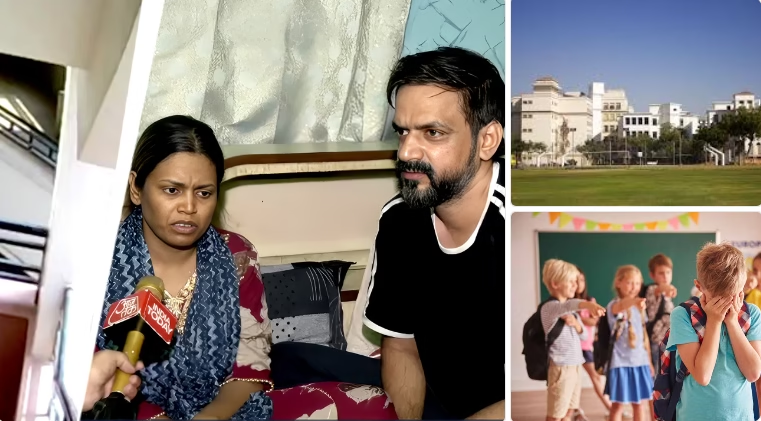


The tragic death of 9-year-old Amayra Meena at a Jaipur school exposes India’s growing student-suicide crisis. Here’s the full story, analysis, and advice for parents.
The Tragedy That Shook Rajasthan
On 1 November 2025, a bright young girl named Amayra Meena lost her life after falling from the fourth floor of Neerja Modi School in Jaipur. She was just nine years old.
CCTV recordings captured her final moments — she climbed over a railing moments after speaking with her teacher. By the time she was found, it was too late.
Her family says Amayra had been crying for help for months — bullied by classmates, dismissed by staff, and left feeling unheard. What happened inside that school is now under official investigation, but her death has already raised a much larger question:
Are our schools truly safe — emotionally and physically — for our children?
📚 What Happened at Neerja Modi School
According to reports from NDTV, India Today, and The Week, the incident unfolded during school hours.
After being teased by classmates, Amayra approached her teacher to complain. Instead of immediate help, she was allegedly told to sit down. Minutes later, she walked toward the railing and jumped.
When police and forensic teams arrived, the site had already been cleaned, leaving no visible bloodstains — an act that has now become part of the investigation.
Her parents maintain that the school ignored repeated complaints of bullying and that the building lacked basic safety features like protective grills and secure railings.
🧩 The Family’s Allegations
Amayra’s parents claim:
- Their daughter was constantly bullied, mostly by boys in her class.
- She made several complaints to her teacher and even the school management.
- No preventive action or counselling was provided.
- The school infrastructure was unsafe for younger children.
- A voice message recorded a year earlier had her saying: “Don’t send me to school.”
For the grieving family, these signs were warnings that were missed — or worse, ignored.
🏫 The Investigation So Far
The Rajasthan Education Department has launched an inquiry.
A five-member committee is reviewing safety procedures, CCTV evidence, and the handling of prior complaints.
Meanwhile, CBSE has sought a report on compliance with child-protection norms.
Critics argue that this tragedy exposes a pattern — a system that reacts after disaster strikes, rather than preventing it.
📊 The Bigger Picture: A Rising Crisis in India
Unfortunately, Amayra’s case isn’t an isolated tragedy.
According to National Crime Records Bureau (NCRB) data:
- 13,892 students died by suicide in 2023 — a 65% increase over the past decade.
- That’s almost 38 students every day.
- Causes range from bullying and academic stress to lack of emotional support.
Behind every statistic is a name, a classroom, and a silence that went unheard.
😔 The Link Between Bullying & Suicide
Global research consistently connects peer bullying with depression and self-harm.
A 2023 multi-country study found that students who are bullied are 2.5× more likely to experience suicidal thoughts.
In India, the problem often hides behind stigma — children are told to “ignore it,” “be strong,” or “not make a fuss.”
But emotional pain in young minds doesn’t vanish; it festers until it breaks.
Amayra’s repeated complaints were her way of asking for help.
The tragedy is that adults — the very people meant to protect her — didn’t listen soon enough.
🚨 Why Parents Need to Pay Attention
Even the most loving parents can miss subtle warning signs.
Here are key things every parent should know:
- Listen beyond words
If your child says they don’t want to go to school, ask why. Don’t dismiss it as laziness or drama. - Watch for changes
Sudden withdrawal, mood swings, poor appetite, or frequent complaints of “headache” or “stomach pain” may signal distress. - Document and escalate complaints
Always submit bullying concerns in writing and demand follow-ups from teachers or the principal. - Ask about safety infrastructure
Visit the school. Are there safety nets or railings on higher floors? Is supervision constant during recess? - Promote resilience
Encourage friendships, emotional expression, and hobbies outside academics. - Take every sign seriously
Phrases like “I can’t take it anymore” or “I just want to disappear” are red flags that require immediate counselling.
🏛️ What Schools Must Do — Beyond Promises
Schools are legally and morally responsible for child safety.
Every institution must:
- Have a clear anti-bullying policy with written procedures.
- Employ trained counsellors and conduct regular emotional-wellness sessions.
- Ensure CCTV with audio where privacy laws permit.
- Install protective barriers or nets in multi-storey buildings.
- Maintain transparency — if a child complains, inform parents the same day.
- Preserve all evidence in case of incidents; never clean or alter the scene.
When these basics are missing, tragedy becomes inevitable.
💬 A Message to Policymakers
- Mandatory annual safety audits in every school.
- Mental-health cells under each district education office.
- Integration of emotional-intelligence and peer-support training from Class 1 onwards.
- Strict penalties for non-compliance with child-protection laws.
The rise in student suicides isn’t just a statistic — it’s a national emergency that needs policy, not platitudes.
❤️ Final Thoughts: Listening Could Save a Life
Amayra’s story is more than a headline. It’s a mirror held up to every parent, teacher, and policymaker.
When a child says, “Don’t send me to school,” it’s not defiance — it’s despair.
Let her story not fade into another forgotten case file.
Let it compel us to build schools that value kindness as much as achievement, empathy as much as excellence.
Because no grade, no institution, and no adult’s ego is worth a child’s life.
If your child or student is in distress:
Talk. Listen. Seek professional help.
Your attention today might be the reason they see tomorrow.