

Trump Declares US Oversight of Venezuela: Navigating the ‘Safe Transition’ Era-Table of Contents
- Introduction: A Bold Declaration Shakes Global Politics
- The Context: Venezuela’s Turmoil and US Intervention
- Trump’s Statement: Decoding the ‘Safe Transition’ Plan
- Historical Parallels: Lessons from Past US Involvements
- Potential Impacts on Venezuela’s Economy and Society
- Global Reactions: Allies, Rivals, and Neutrals Speak Out
- Legal and Ethical Dilemmas: Sovereignty vs Stability
- Challenges Ahead: Security, Governance, and Reconstruction
- Opportunities for Positive Change: A Roadmap to Recovery
- Public Opinion: Divided Views in the US and Beyond
- Conclusion: The Long Road to a Stable Venezuela
Introduction: A Bold Declaration Shakes Global Politics- Venezuela
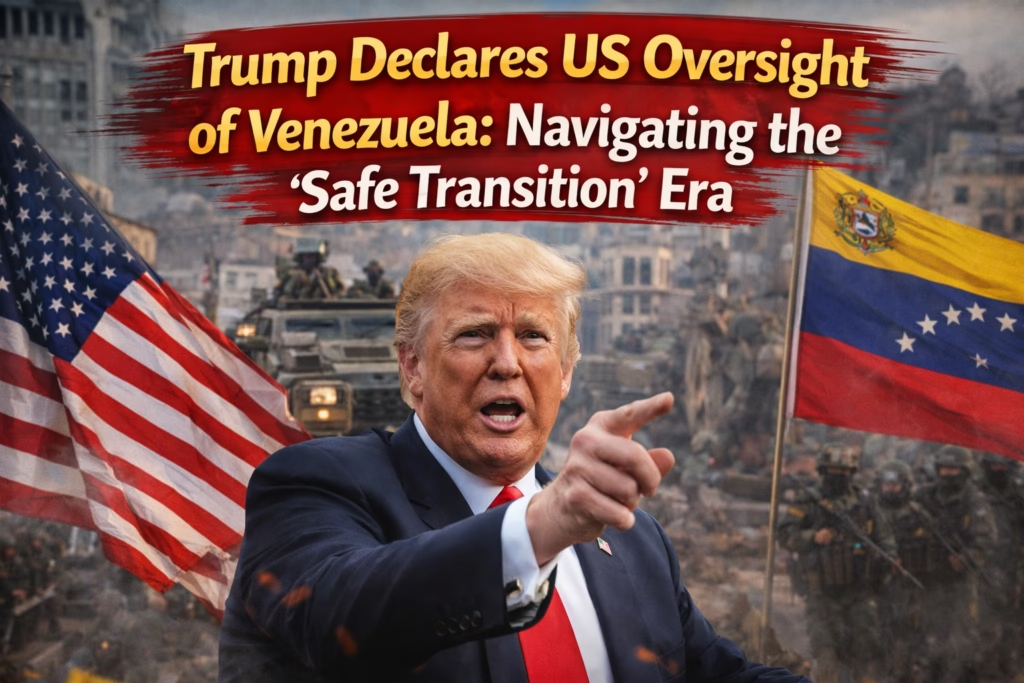
On January 4, 2026, President Donald Trump made headlines with a stunning announcement: The United States will administer Venezuela until a “safe transition” to stable governance is achieved. This declaration, delivered during a White House press briefing, follows the dramatic capture of former President Nicolás Maduro in a US-led operation just days prior. As the world grapples with the implications, this move signals a new era in US foreign policy—assertive, unilateral, and unapologetic. For zikzik.in readers, this blog explores the announcement’s origins, potential outcomes, global responses, and the delicate balance between intervention and sovereignty. Is this a path to democracy or a recipe for prolonged conflict? Let’s unpack the details.
The Context: Venezuela’s Turmoil and US Intervention
Trump Declares US Oversight of Venezuela: Navigating the ‘Safe Transition’ Era
Venezuela’s descent into crisis began long before Trump’s statement. Once Latin America’s richest nation, it has endured hyperinflation (over 1 million percent in 2018), food shortages, and mass migration (7 million refugees by 2025) under Maduro’s rule since 2013. Accusations of election rigging, human rights abuses, and drug trafficking led to US sanctions starting in 2017.
The tipping point came in late 2025 with escalating tensions. Maduro’s alliances with Russia, China, and Iran, coupled with alleged support for regional instability, prompted the US to act. On January 3, 2026, US forces conducted “Operation Liberty Dawn,” capturing Maduro in Caracas with minimal casualties. Trump’s follow-up declaration positions the US as Venezuela’s interim overseer, citing humanitarian needs and regional security.
This isn’t unprecedented—US interventions in Panama (1989) and Iraq (2003) aimed at regime change. But Venezuela’s oil reserves (largest globally) and strategic location add layers of complexity.
Trump’s Statement: Decoding the ‘Safe Transition’ Plan
Trump’s exact words: “The United States will run Venezuela until a safe transition of power is complete. We’re not occupying—we’re stabilizing. Maduro’s gone, and we’re stepping in to ensure fair elections and rebuild what he destroyed.”
The plan includes:
- Interim Administration: US-led coalition with Venezuelan opposition figures overseeing daily governance.
- Election Timeline: Supervised elections within 6–12 months, with international observers.
- Humanitarian Aid: $10 billion pledged for food, medicine, and infrastructure.
- Security Measures: US troops (estimated 5,000) for “protection,” not occupation.
Critics argue this violates sovereignty; supporters see it as necessary to end chaos.
Historical Parallels: Lessons from Past US Involvements
Trump’s approach echoes past interventions:
- Panama 1989: US captured Manuel Noriega on drug charges—led to democratic transition but initial resentment.
- Haiti 1994: Operation Uphold Democracy restored Aristide—short-term stability, long-term instability.
- Iraq 2003: Saddam Hussein’s capture sparked insurgency—warning of power vacuums.
Lessons: Unilateral action risks backlash; inclusive transitions succeed. Venezuela’s case differs—less military resistance, more humanitarian focus—but parallels warn of prolonged involvement.
Potential Impacts on Venezuela’s Economy and Society
- Economic Revival: US oversight could lift sanctions, stabilize oil production (3 million barrels/day potential), attracting investment. Inflation (25% in 2025) could drop to single digits.
- Social Rebuilding: Aid addresses malnutrition (affecting 30% children); education/health reforms rebuild trust.
- Risks: Dependency on US aid fosters resentment; corruption scandals could arise.
- Migration Reversal: With stability, refugees (8 million) may return, easing regional strain.
Short-term chaos possible—protests, supply disruptions—but long-term growth if managed well.
Global Reactions: Allies, Rivals, and Neutrals Speak Out
- Allies Back US: UK, Canada praised “humanitarian intervention”; EU urged quick elections.
- Latin America Divided: Brazil, Mexico condemned “imperialism”; Colombia, hosting 2 million refugees, supported.
- Rivals Condemn: Russia called it “illegal aggression,” vowing UN action; China warned of economic retaliation; Iran threatened asymmetric responses.
- Neutrals Observe: India advocated dialogue; African Union expressed concern over sovereignty.
- UN Stalemate: Security Council vetoes blocked resolutions; Guterres called for restraint.
Reactions highlight polarized world—US power tested.
Legal and Ethical Dilemmas: Sovereignty vs Stability
Legally, UN Charter prohibits force except self-defense or Security Council approval—critics cite violation. US argues humanitarian intervention under R2P doctrine.
Ethically, removing Maduro (accused of crimes against humanity) justifies, but unilateralism risks precedent for superpowers. Human rights groups applaud end to repression but warn of occupation pitfalls.
Dilemma: Stability at sovereignty’s cost?
Challenges Ahead: Security, Governance, and Reconstruction
- Security: Guerrilla resistance from Maduro loyalists possible; US troops face IED risks.
- Governance: Interim council must avoid corruption; fair elections key to legitimacy.
- Reconstruction: Oil revival needs $100 billion investment; hyperinflation control requires IMF aid.
- Humanitarian Hurdles: Aid distribution amid chaos; refugee returns strain resources.
Success hinges on inclusive, transparent transition.
Opportunities for Positive Change: A Roadmap to Recovery
- Economic Boom: Revived oil could GDP triple in 5 years.
- Democratic Dawn: Free elections empower Venezuelans.
- Regional Stability: Reduced migration eases neighbors’ burdens.
- US Legacy: If successful, boosts Trump’s doctrine; if not, backfires.
Opportunities abound if collaboration trumps control.
Public Opinion: Divided Views in the US and Beyond
US polls: 52% support (Pew 2025), with Republicans at 75%, Democrats at 30%. Venezuelans: 60% welcome change (local surveys), but 40% fear occupation.
Global sentiment: Anti-US protests in Latin America; pro-democracy rallies in Miami.
Conclusion: The Long Road to a Stable Venezuela
Trump’s January 4, 2026, declaration of US oversight for Venezuela’s “safe transition” is a high-stakes gamble—potentially liberating a nation or igniting conflict. As Maduro faces trial and Venezuela navigates uncertainty, the world watches. This isn’t just politics—it’s human lives at stake. Unity, not unilateralism, may be the key to lasting peace.
Disclaimer
This blog is based on the author’s analysis and publicly available information. It reflects general trends and updates on the Venezuela situation, without intent to mislead. Readers are encouraged to verify details independently. The author and zikzik.in are not responsible for actions taken based on this content.
https://zikzik.in/2026/01/03/us-strikes-venezuela-maduro-captured-in-dari/